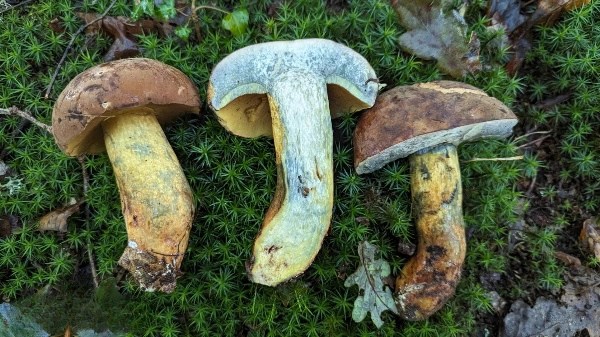
Lanmaoa Asiatica: The Mushroom That Populates the Room with Tiny Marching Men
In 2025, a study was shared in which experts examined a mushroom that causes fairytale-like hallucinations. This mushroom, which belongs to a class of fungi completely different from the more commonly known “magic mushrooms,” is even more mysterious when it is not fully cooked, as it reportedly causes those who eat it to suddenly see hundreds of tiny people, as if in a cartoon or in an imaginary Lilliput. These beings then begin to march across the tablecloth, jump into the plate, swim in the soup, or, much like in an episode of Urusei Yatsura by Rumiko Takahashi, revel, distract, or tease the person experiencing the hallucinations.
Lanmaoa Asiatica, or Jian Shou Qing, are the scientific and common names of this mushroom. In the Chinese province of Yunnan, which hosts 40% of the world’s edible wild mushrooms, it is possible to encounter this mushroom even by chance at the mushroom market stalls scattered throughout the capital, Kunming. I personally bought the psychoactive mushroom, the one said to make people see little figures and experience Lilliputian hallucinations. Why didn’t I see the little people? When I returned home and was in the kitchen, I began cutting the mushroom, which I believed to be a simple, common bolete, but the mushroom turned blue. Concerned, I asked whether this was normal, and when I was told it could be a poisonous mushroom, I decided to throw it away and not cook it.
A few days later, I observed a rare natural chemical reaction, uncommon in everyday life. The vegetable scraps, together with the mushroom, had significantly altered the pigmentation of the common molds present in my garbage bag, giving rise to a composition of “psychedelic” colors resulting from natural chemical interactions. This rare convergence was the result of the combination of vegetables, tubers, leaves, and peels, materials characterized by polyphenols, chlorophyll and its derivatives, active plant enzymes, variable pH, and complex sugars. This type of waste is chemically far more reactive than scraps containing pasta, bread, or dairy products. The role of the mushroom that turns blue when cut, an indication of the presence of oxidizable phenolic compounds and unstable pigments, contributed to the formation of a complex biochemical substrate, different from that typical of a European kitchen.
Raw blue-staining mushrooms, partially cut and discarded together with only vegetable scraps in a humid, closed environment, created a rare combination of conditions that produced highly saturated colors with a “living,” dynamic appearance. Inside the bag, three processes occurred simultaneously: the transformation of the mushroom’s blue pigments; interaction with plant pigments such as chlorophyll, carotenoids, and flavonoids; and changes in the pigmentation of common molds in response to a plant-based substrate rich in phenols. This convergence generated unnaturally intense greens, highlighter-like yellows, and irregular, almost luminescent surfaces. It was a rare reaction between materials that do not normally meet, in which the blue-staining mushroom altered the chromatic behavior of common molds, resulting in a visually unusual chemical interaction that I have never observed again.
Hidden Worlds: Why Some See Gnomes, Fairies, or the Little People
In the accounts of the first foreigners who set out for the western highlands of Papua New Guinea in 1934, it emerges that they encountered a bewildering sight: after consuming a type of wild mushroom they called “Nonda,” the local people appeared to go temporarily mad, showing a sudden and striking change in mood and behavior. Subsequent reports of the phenomenon of “mushroom madness,” as it came to be known, provided further details about the strange psychological effects of the fungus. In the 1960s, some scientists attempted to identify the mushroom species involved and which chemical substances contained within them might be responsible for such bizarre effects. However, both questions remained unanswered until today. Doctoral student Colin Domnauer at the Utah Museum of Natural History has worked to solve this mystery: what exactly is the identity of this mushroom, how widespread is the cultural knowledge of its effects, and why does it produce such fantastical and incredible visions?
Over the past decade, the summer rains that have led to a much greater abundance of mushrooms in China have also coincided with a surge in local newspaper articles reporting on people who, after consuming a wild mushroom dish known locally as “Jian shou qing,” often described having incredibly bizarre experiences. The most well-known of these is characterized by visions of “xiao ren ren,” or little people.
Colin Domnauer further reports that one evening, during a dinner, a professor from Yunnan began seeing swirling shapes and colors after eating sautéed mushrooms. Being aware of the psychoactive effects, and given that over the past decade most local people have come to know about these mushrooms, he immediately began looking for “xiao ren ren,” but was disappointed not to find any. However, after lifting the tablecloth and peeking underneath, he stated that he saw “hundreds of ‘xiao ren ren,’ marching like smiling soldiers.” He even measured them, they were 2 cm tall. Colin Domnauer reports that, according to records from Yunnan hospitals, 96% of patients who consume this mushroom report seeing a multitude of “little people” or “elves,” often dancing, jumping, or marching within their real environment.
In 2014, the taxonomic identity of the psychoactive mushroom Jian shou qing was formally established. This was made possible thanks to several mycologists from Yunnan who purchased and sequenced mushrooms sold at an open-air market and officially recognized a species that had never before been identified by science. Its formal Latin name is Lanmaoa asiatica, and, interestingly, it is more closely related to the common porcini mushroom than to any other hallucinogenic mushroom species currently known.
This vision-inducing mushroom turns out to be one of the most common edible species and is normally sold in Yunnan. Lanmaoa asiatica, or Jian shou qing, roughly translates as “turns blue in the hand,” referring to its rapid color change upon contact. This mushroom is highly valued for its unique and rich flavor, and it is equally well known for its powerful hallucinogenic effects if insufficiently cooked; many people recount stories of fantastical perceptions. Although this scientific discovery is recent, knowledge and use of this psychoactive mushroom may have much older roots in Chinese culture, as well as in Western traditions, through comparable forest mushrooms found in Europe.
An important Taoist text from the 3rd century CE refers to a “mushroom of the spirit of the flesh” which, according to the text, if consumed raw allows one to “see a small person” and to “immediately attain transcendence.” It is worth noting that mushrooms such as Boletus or Pleurotus ostreatus are, by definition, described as fleshy because of the structural, meat-like sensation they give to the palate and tongue.
Colin Domnauer also reports another mushroom that has caused hallucinations of little people or the “little folk,” known as “ansisit,” which is consumed within indigenous communities of the remote Northern Cordillera of the Philippines. The mushroom is locally known as “Sedesdem.” This culturally valued wild edible mushroom also produces bizarre psychoactive effects if insufficiently cooked. The fact that the same peculiar hallucinations are independently reported in cultures so distant from one another indicates that these phenomena, which may appear to be purely psychological effects, are not cultural inventions or coincidences, but manifestations of a shared chemical and neurological basis. These visions, present in many folkloric accounts, therefore testify to a global experience and are more than folklore or fantastical stories; they are chemical in nature, not madness or mere superstition. Many such accounts were confined to the realm of fantasy and childhood because, until now, there had been no concrete evidence. Moreover, no scientific investigations as accurate and detailed as the recent studies reported had ever been conducted on these mushrooms.
Colin Domnauer reveals that chemical and genomic analyses performed on Lanmaoa asiatica at the Utah Museum of Natural History have not detected traces of any known psychoactive compounds, suggesting that something entirely new is waiting to be discovered. The research aims to progressively narrow the field and isolate the specific bioactive molecules involved. In short, Lanmaoa asiatica appears to host a chemical compound capable of reliably evoking this unusual hallucinatory experience. The discovery of this chemical substance could, in fact, hold the key to understanding one of the oldest and most mysterious dimensions of the human psyche, linked to the world of fairy tales, legends, and folklore.
Alongside the chemical study, Colin Domnauer is also creating a global database of all species related to this mushroom, and in doing so has discovered four new species previously unknown to science. Through full genome sequencing, he has been able, for the first time, to clearly map the evolutionary relationships and part of the history of this mushroom, allowing him to search for patterns that might reveal where and why psychoactivity evolved within this group of fungi. For example, genomic analysis revealed that a close relative of this mushroom is a species commonly present (though rarely eaten) in North America. Although there are no reports of psychoactive effects, it is entirely plausible that such effects may simply have gone unnoticed, been underestimated, or dismissed due to bias against those who reported them. It should be remembered that different individuals can have different experiences depending on physical composition, weight, and age, and that in the West, generations raised within patriarchal cultures have often been met with dismissive or denigrating remarks, or with common phrases such as, “That can’t be!”
A Seemingly Harmless Mushroom Dish
So-called hallucinogenic porcini mushrooms, also known as psychoactive porcini or “xiao ren ren (小人人)” mushrooms, have been reported in Papua New Guinea, China, and the Philippines. Although they produce hallucinogenic effects, their exact identification, active compounds, and mechanisms of action have not yet been fully clarified. The species most commonly under investigation is Lanmaoa asiatica. The Lilliputian hallucinations associated with these mushrooms represent a distinct form of experience, different from the effects produced by other well-known hallucinogenic mushrooms such as psilocybin-containing species or Amanita muscaria, which act through different neurochemical pathways.
Post Author


/cdn.vox-cdn.com/uploads/chorus_asset/file/25703391/247215_Holiday_GG_2024_AKrales_MAIN_LEDE_2040x1360.jpg?w=100&resize=100,70&ssl=1 "The Verge’s 2024 holiday gift guide")
