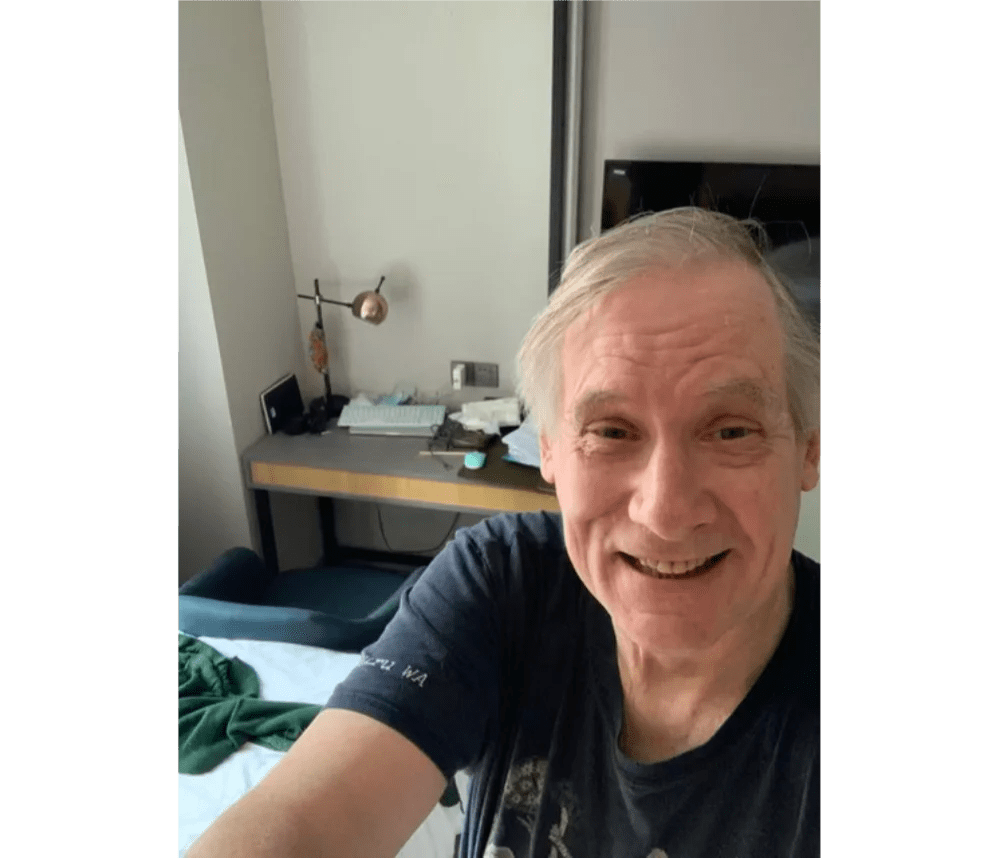
Former diplomat Adam Williams returns to historical fiction with a medieval Egyptian murder mystery
Adam Williams writes historical novels that pull apart the mechanics of power and violence in distant centuries. Born in Hong Kong, he spent decades in the machinery of international trade, Jardine Matheson, the British Chamber of Commerce in Beijing, before turning to fiction full-time. His previous books include The Palace of Heavenly Pleasure and The Book of the Alchemist, the latter a prequel to his new novel A River of Blood, published by Earnshaw Books.
A River of Blood drops a Jewish alchemist-physician and his English apprentice into 1099 Cairo, where the Nile runs red and corpses accumulate. Samuel, the doctor, approaches murder like a problem of method, observation, hypothesis, obstruction from authorities who would rather he stop asking questions. What begins as an investigation becomes something larger: a secret that could fracture an empire, a child marked for death, assassins moving through the streets. Williams knows how religious tension, political ambition, and bodies in the wrong place can ignite. He lives in Beijing with his wife, the writer and filmmaker Hong Ying.
How did you balance historical accuracy with the compelling narrative of a thriller and mystery novel?
History is sacrosanct, but not always reliable, and often full of holes. You can’t argue with fact, but a historical novel, like Heineken’s famous beer advert that reaches those parts that other beers, or histories, cannot reach, just might tell a story that could be true. The rigour therefore for a historical novelist to seek out fact is as much or more so than that of a scholar seeking out sources. This applies to whatever is the brand of story – thriller, mystery or romance.
What was the inspiration for the plot that weaves together medieval science, Fatimid politics, and a series of mysterious murders?
After I had written four successful historical novels, my then publisher, Carolyn Mays, of Hodder, told me that the demand for romantic histories was waning and upcoming were whodunnits and murder stories. Puzzling about this, I recalled Agatha Christie (of course) and her famous ‘Death on the Nile’. That made sense because the main character of my last book, a philosopher and alchemist, ended up in Egypt. There it was: Egypt, Death on the Nile, but in a story that took place 1000 years ago. Let’s start with a discovery of a corpse on the riverbank, I thought. Little did I know what a strange environment I had set for myself, and how much more research I needed to undertake.

How did your background in Beijing and your life in Asia influence your perspective in telling a story set in 11th-century the Middle East?
I am descended from British missionaries, doctors and railway engineers who came out to China at the end of the nineteenth century, their descendants staying on till World War II, later returning after the War to the Far East as businessmen. I was born in Hong Kong and listened to their stories, and was able in my turn to incorporate some of my grandmother’s anecdotes into my first two books – but I suspect my ancestors if they were still living would not have approved of what I did with my characters in their fictitious adventures, for I was basing my books on hard research. It was a matter of pride for me that my China trilogy, when I played out my stories of China’s history in the decades that followed had been based on all the memoirs and histories I had read on the Boxer Rebellion, the civil wars of the 1920s, the Great Leap Forward, the Cultural Revolution of the 1960s and the Tiananmen Massacre of 1989, which I actually witnessed from my balcony and incorporated into my historical novel. Fiction was grist to the mill of entertainment, but I also had the satisfaction of knowing that what I wrote was plausible. And afterwards, in a book that left China, moving into the direction of the Spanish Civil War, I mixed in a backstory of mediaeval Andalucia in which I could be reasonably confident that what I was writing was believable.

Could you describe your research process that led to the creation of complex characters like Samuel, Gregory, and Zumurrud?
A theme of the novel is slavery and exile. These three protagonists have all suffered loss, indignity and shame. Samuel, though a professor in the Dar al-Ilm, Cairo’s University, grieves over the death of his lover and his new life far away from home. Gregory, a young Saxon, who once had dreams of becoming a doctor has been enslaved in a raid on Sicily by Arab war ships and thanks to Samuel’s help now has papers, and Zumurrud, once a doctor’s daughter, has been sold into prostitution by pirates and reduced to being a maid in a merchant’s house. All are seeking dignity again, and in each other’s company try to find purpose by solving a murder – but their enquiries bring them into danger for their own lives.
What were the greatest challenges in researching historical details to accurately portray Fustat and Qahira in the novel?
In 1099 when this story is set, Fustat and Qahira (later joined into one metropolis, Cairo) was one of the greatest trading ports in the world. The challenge was to bring this world to life. Luckily many contemporary writers of the fictitious Samuel have written in wonder on this marvel of the world, the remains of which we can still see to this day. With Andre Raymond’s wonderful history of ancient Cairo in hand, I spent two weeks walking the streets of modern Cairo where old buildings – mosques, palaces, fortresses, funduqs – a sort of caravanserai which in Fustat rose to tall heights like mini skyscrapers – brought the old twin city to life in my imagination.
Was your decision to write a prequel (“The Book of the Alchemist”) planned, or did it emerge after you had started writing “A River of Blood”?
I did not view The Book of the Alchemist as a prequel but its historical place and timing not to mention the character of Samuel was enough to make him perfect for the part of a detective in the new genre of whodunnit I was embarking on.
Could you explain how you used the history of the Crusaders and the reaction of the Islamic world as a backdrop rather than the main theme of your book?
This is a novel in two parts -the first volume “A River of Blood’ (soon to be published)
traces random murders in the city of Cairo. Samuel and his two helpers follow trails leading higher into the thorny nest of politics and ultimately incur the anger of the Caliphate itself, for this is a race to save an innocent mother and child, the real heir to the Fatimid throne. Meanwhile the state itself is arming for battle. In Syria and Palestine, European armies have been acting as mercenaries, ostensibly fighting for the Byzantines but with a hidden aim to take Jerusalem for God and themselves. How can Samuel and his friends find and save the mother and child whom they believe are hidden in Jerusalem before Armageddon descends on the Middle East? The outcome will be revealed in Part 2 “A Sea of Tears “, which will be published shortly after “A River of Blood’
Is there a specific reason why you chose to set the story in 1099, such a pivotal year for the Middle East?
Of course! The news of the sack of Jerusalem particularly the barbarism of the crusaders fired Islam with anger and still does so. Osama Bin Laden described it as the beginning of the Thousand Year War, and contemporary atrocities in Gaza and Palestine hark back centuries. In its way this is a topical book.
What impact did reading historical texts that described the violence and brutality of the Crusades from an Arab perspective have on you?
I was not surprised. What we and our European countrymen did on that night and a day was barbaric, a communal madness, as if on a marijuana high though the drugs were in their own minds. One text that gripped me was written by a monk sometime afterwards, describing how the blood ran down the tight stairways in torrents from the Golden Mosque where old men and women, mothers and children had been hacked to death inside by axe men, while onlookers below amused themselves watching horses ride up to their withies in blood, Praise be to God.
This is clearly impossible – no amount of human blood could cause such a stream – but l will keep the scene in the novel– the young man’s broken mind recounting this in my story is imagining such things. Horrors do affect memory. And after all the book’s title is “A River of Blood.”
The Caliph’s character, a “spoilt, cruel and very disturbed young man,” was inspired by specific historical figures, or is it your invention?
I was not able in my reading to find much at all about the character of the Imam Caliph whom the Wazir, his father-in-law, put on the throne, after killing the real heir to the throne and marrying the new Caliph to his daughter. The Wazir clearly had the young man under his thumb after the coup d’etat. Finding out nothing particularly about him, I’m afraid I indulged myself with an invention!
Your passion for history began with the novel “Knight Crusader.” What is your emotional relationship with that story after writing a novel that deconstructs the romantic side of the Crusades?
Oh, the romantic side of me still rules! I will never forget my love for Ronald Welch’s story!
Photo courtesy of Adam Williams
Post Author


